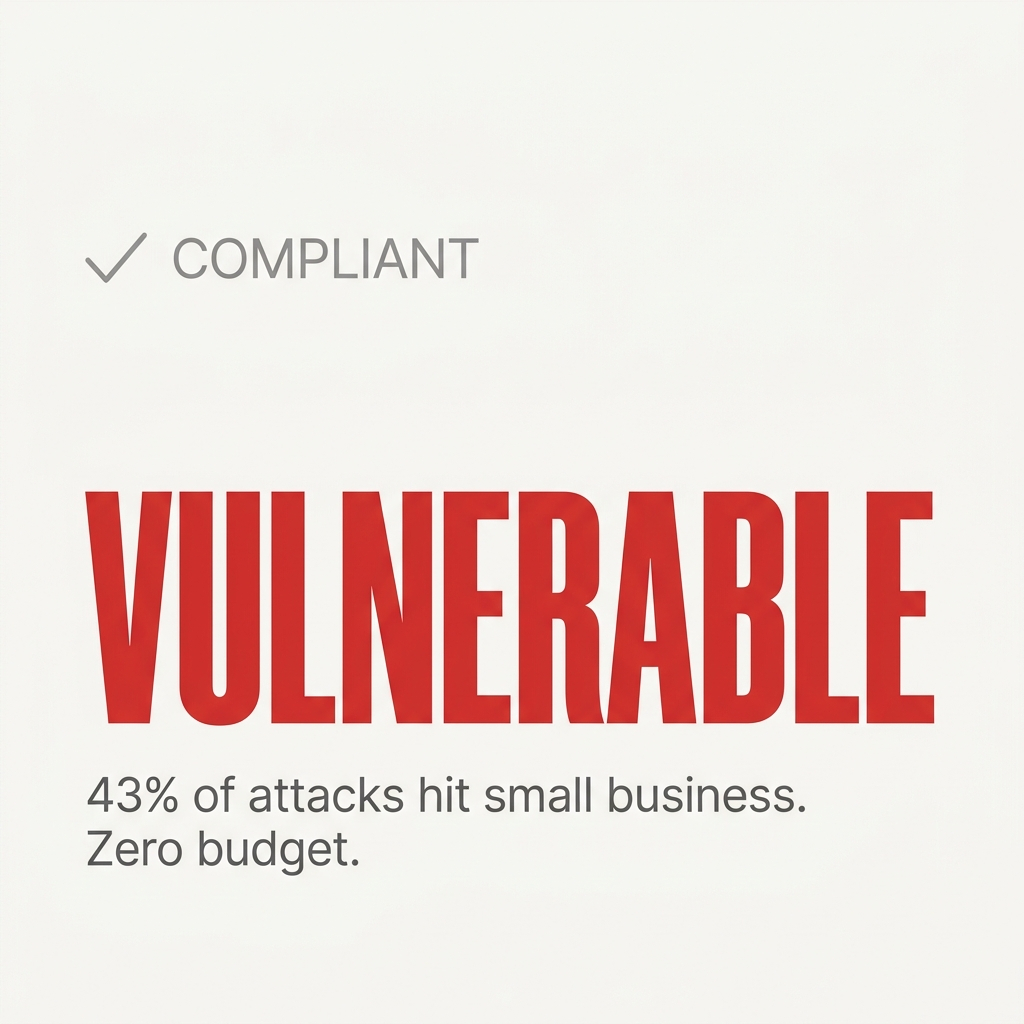
I spent last Tuesday watching a 60-employee financial services firm celebrate passing their compliance audit. The champagne came out. The CEO sent an all-hands email about their commitment to security. Three weeks later, they called us in a panic because ransomware had locked every file in their system.
They had passed the audit. They had checked every box. They were compliant on paper. They were also completely vulnerable in reality.
This happens more often than anyone wants to admit. The gap between compliance and actual protection has become so wide that most small businesses are operating in what security experts call “cybersecurity theater.” They’re performing security rather than implementing it.
The Numbers Tell a Brutal Story
The data reveals a pattern that should terrify every business owner. 43% of all cyberattacks in 2025 targeted small businesses. Not Fortune 500 companies with massive security budgets. Small businesses. The ones who think they’re too small to matter.
Even more troubling, 82% of ransomware attacks hit companies with fewer than 1,000 employees. These aren’t theoretical risks. They’re statistical certainties playing out across every industry we work with.
The math becomes even more brutal when you look at preparedness. Only 13% of small firms conduct proactive cybersecurity audits. Only 22% perform regular vulnerability scanning. Only one in five conducts annual penetration testing. The majority are flying blind, hoping their antivirus software and firewall will somehow protect them from threats that evolve daily.
Here’s what makes this dangerous: 47% of businesses with fewer than 50 employees allocate zero cybersecurity budget. Zero. They’re spending nothing on prevention while facing threats that cost an average of $120,000 to recover from. Prevention is 50 to 60 times cheaper than recovery, yet most small businesses choose to gamble on never getting hit.
The Compliance Trap Creates False Security
I’ve watched this pattern repeat across dozens of clients. A company hires an auditor. The auditor reviews their systems against a compliance framework. The company implements the minimum requirements to pass. The auditor signs off. Everyone believes they’re protected.
The problem is that compliance frameworks measure whether you followed specific procedures. They don’t measure whether those procedures actually protect you from current threats. Compliance is backward-looking. It codifies what we knew about security threats when the framework was written. Cybersecurity is forward-looking. It responds to threats that didn’t exist when your audit happened.
The Target breach proved this brutally. The company had passed its PCI-DSS audit just weeks before hackers stole 40 million credit card records. They were compliant. They were also compromised. The audit measured their adherence to documented procedures. It didn’t measure whether those procedures stopped sophisticated attackers.
This creates what security researchers call “the compliance gap.” Companies that suffered major breaches in 2024 were largely compliant with relevant regulations at the time of the incident. Compliance didn’t protect them because compliance is the floor, not the ceiling. It’s the minimum standard required to operate legally. It’s not a security strategy.
Why Theater Feels Like Protection
Cybersecurity theater works because it creates visible evidence of action. A company installs antivirus software on every machine. They implement a password policy. They conduct annual security training. They pass their audit. All of these actions are visible. All of them feel like progress.
The problem is that these measures often address yesterday’s threats while leaving critical vulnerabilities untouched. Security theater emphasizes high-visibility controls that give the illusion of safety while leaving the actual attack surface unaddressed.
I see this most clearly in how companies handle employee security. Employees of small businesses experience 350% more social engineering attacks than those at larger enterprises. Yet only 34% of small businesses have a formal incident response plan. They’re being targeted aggressively but have no documented process for responding when someone clicks a malicious link or downloads infected files.
The human factor amplifies every other vulnerability. In 2025, employee mistakes caused 41% of cybersecurity incidents in small enterprises. Poor password hygiene remains epidemic, with 68% of employees reusing passwords across platforms. Companies implement password policies that employees circumvent immediately because the policies prioritize compliance documentation over practical security.
The Cost of Pretending
The financial impact of this gap between theater and protection shows up in recovery costs that destroy businesses. A single ransomware incident averages $120,000 in recovery costs. For most small businesses, that’s an existential threat. 75% of small and medium businesses say they could not continue operating if they were hit with a ransomware attack. 78% fear that a major cyber incident could put them out of business entirely.
These aren’t abstract possibilities. I’ve watched companies fold because they couldn’t absorb the recovery costs. I’ve seen business owners lose everything they built because they believed their compliance certification meant they were protected.
The disconnect between confidence and capability makes this worse. Last year, 96% of companies reported confidence in their ability to detect and respond to cyberattacks in real time. Yet only 5% increased their cybersecurity budgets. That level of confidence without corresponding investment suggests most companies don’t understand their actual risk exposure.
What Real Protection Looks Like
Real cybersecurity starts with accepting that threats evolve faster than compliance frameworks. A new vulnerability discovered three days after your auditor leaves makes you 100% vulnerable in reality, even though you remain 100% compliant on paper. Cybersecurity is a continuous fight, not an annual checkbox exercise.
The companies that survive this environment build security around three principles that compliance frameworks rarely measure. First, they assume compromise is inevitable and build detection and response capabilities accordingly. IBM data shows a tested incident response plan and trained team reduces breach costs by $232,007. That’s not theoretical. That’s quantifiable protection that comes from preparing for failure rather than assuming prevention alone will work.
Second, they invest in proactive monitoring and threat hunting rather than relying on annual audits to identify vulnerabilities. Threats don’t wait for your audit cycle. The gap between audits is when attackers operate most freely because companies believe their compliance status means they’re protected.
Third, they treat employee security as an ongoing operational challenge rather than an annual training requirement. The weakest link in most security systems isn’t the technology. It’s the assumption that checking a training completion box equals actual behavior change. Real security requires continuous reinforcement, regular testing, and immediate response when employees make mistakes.
Moving Beyond Theater
The path forward requires accepting an uncomfortable truth. Compliance is necessary but insufficient. You need to pass audits to operate legally in regulated industries. You also need to recognize that passing audits doesn’t mean you’re protected from current threats.
This means building security programs that exceed compliance requirements. It means investing in capabilities that auditors don’t measure because they’re too new or too specific to your environment. It means treating cybersecurity as an operational discipline rather than a periodic certification exercise.
Most importantly, it means abandoning the belief that visible security measures equal actual protection. The champagne celebration after passing an audit should be replaced with the recognition that you’ve met the minimum legal standard. The real work of protecting your business happens in the gap between compliance and actual security.
I’ve spent 40 years watching technology evolve. The one constant is that complexity never decreases. The threat landscape doesn’t stabilize. The businesses that survive are the ones who build operational discipline before the next wave arrives, not the ones who wait for their annual audit to tell them what to fix.
Stop pretending compliance equals protection. Start building security systems that assume threats will evolve faster than your last audit. The cost of getting this wrong isn’t just financial. It’s existential.